
Esports Betting Guide: Rules, Markets, and Risks Explained
Learn the basics of esports betting, including rules, popular betting markets, and potential risks. Understand how esports betting works and why responsible betting is important.
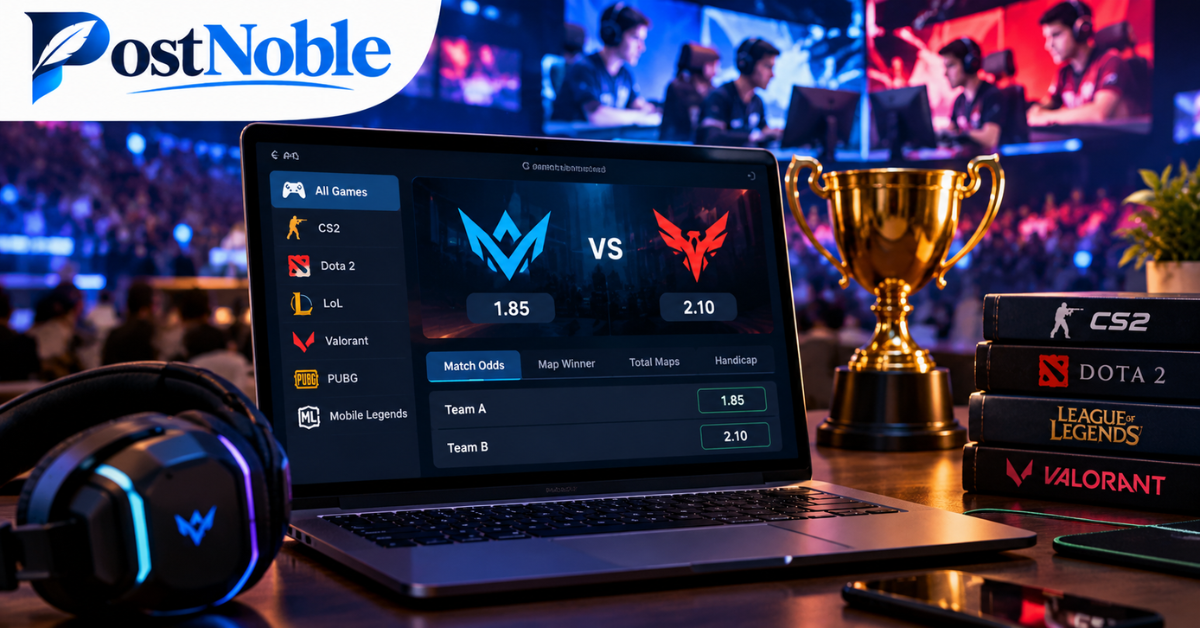
Esports has grown from a niche gaming hobby into a global form of entertainment, attracting millions of viewers who follow professional players, competitive teams, and major gaming tournaments. Titles such as Counter-Strike 2, League of Legends, Dota 2, and VALORANT have helped build competitive gaming communities where every round, strategy, and player decision can influence the outcome of a match.
As esports audiences continue to expand, betting on competitive gaming has also gained attention. For newcomers, however, understanding how it works can be challenging. Different games follow different rules, betting options vary between competitions, and unexpected match developments can make outcomes difficult to predict.
This esports betting guide from PostNoble explains the basic rules, common betting markets, and potential risks in straightforward language. Whether you are researching the topic out of curiosity or learning about the esports industry, understanding these fundamentals can help you make more informed decisions.
What Is Esports Betting?
Esports betting involves placing a wager on the possible outcome of a competitive video game match or tournament. Depending on the event and the operator, available options may include predicting the winning team, the number of maps played, or specific match statistics.
The process shares some similarities with traditional sports betting, but esports has its own characteristics. Results can depend on team coordination, player form, game updates, map selection, and strategic decisions made during a match.
For example, in a professional Counter-Strike 2 match, two teams might compete across several maps. A betting market could focus on which team wins the series or which team wins a particular map. In a League of Legends tournament, the options may be different because the game uses distinct objectives, team compositions, and match formats.
Understanding the game itself is important because each title has different mechanics and competitive structures.
How Does Esports Betting Work?
Although individual platforms may have different procedures, the general process usually follows a few basic steps.
1. Understand the competition
Start by learning about the game, the participating teams, and the tournament format. Check whether the match is a single game, a best-of-three series, or a best-of-five series.
2. Learn the available markets
A market represents the particular outcome on which a wager can be placed. Some markets are relatively simple, such as predicting the match winner, while others depend on specific in-game events or statistics.
3. Understand the odds
Odds indicate the potential return associated with an outcome and reflect how the operator prices that possibility. They do not guarantee an accurate prediction. Different odds formats may be used, including decimal, fractional, and American odds.
For instance, decimal odds of 2.00 represent a total return of ₹200 on a hypothetical ₹100 stake, including the original stake, if the selection wins. The actual availability of this example and any applicable fees or restrictions depend on the operator.
4. Review the rules before participating
Always read the settlement rules, minimum-age requirements, and applicable terms. Understand what happens if a match is postponed, abandoned, or ruled invalid.
5. Follow responsible practices
Betting should never be treated as a reliable source of income. If participation is legal where you live and you meet the applicable age requirements, set strict limits and avoid wagering money needed for everyday expenses.
Common Esports Betting Markets
One of the most important parts of an esports betting guide is understanding the different markets. Each market focuses on a particular aspect of a competition, and its availability depends on the game, event, and betting operator.
1. Match Winner
The match-winner market involves predicting which team or player will win a particular match. It is one of the simplest markets to understand because the selection focuses on the overall result.
Before evaluating a matchup, viewers may consider recent performances, head-to-head records, player availability, and tournament standings. However, previous results cannot guarantee future performance.
2. Map Winner
Many esports competitions use a series of maps rather than a single continuous game. In these formats, a map-winner market focuses on which team wins an individual map.
Map selection can be particularly important in games such as Counter-Strike 2. Some teams perform better on certain maps because of their strategies, preferred positions, and practice routines.
Even so, map-specific statistics should be interpreted carefully. A team's historical success does not mean it will necessarily perform well in its next match.
3. Over/Under Markets
Over/under markets focus on whether a particular statistic will finish above or below a specified number. Depending on the game, the statistic might involve total maps, rounds, or other measurable match outcomes.
For example, a market might ask whether a best-of-three series will require more than two maps. The answer depends on the competition format and the result of the individual games.
Participants should read the exact market description because different operators may apply different settlement conditions.
4. Handicap Markets
Handicap markets adjust the starting position of a team or player for betting purposes. The adjustment may involve maps, rounds, or another defined statistic.
These markets can make a matchup between teams with different perceived strengths more complex. Understanding the handicap value and the settlement rules is essential before interpreting the potential outcome.
5. Tournament Winner
Tournament-winner markets focus on predicting which team or player will win an entire competition rather than one match.
These outcomes can be harder to assess because the selection may need to succeed across several rounds or matches. Draws, bracket positions, fatigue, roster changes, and unexpected upsets can all affect the final result.
6. Live Esports Markets
Live betting allows markets to change while a match is underway. Depending on the operator, options may become available after a round, map, or significant in-game event.
Live markets can move quickly because the odds respond to changing match conditions. This speed can encourage rushed decisions, particularly when viewers become emotionally invested in a team.
For beginners, understanding the risks of live betting is more important than attempting to react to every development.
Key Factors That Influence Esports Match Outcomes
Esports competitions can change rapidly, and no single statistic provides a complete picture of a team's chances. Several factors help explain why predictions can be uncertain.
- Team coordination: Communication and cooperation can determine how effectively players execute their strategies.
- Individual player performance: Mechanical skill, decision-making, and consistency may influence important moments.
- Recent form: Recent match results can provide useful context, although they do not guarantee future success.
- Game updates: Balance changes and new patches may alter character strength, weapon effectiveness, or established strategies.
- Tournament format: A best-of-one match creates different competitive conditions from a longer series.
- Player and roster changes: Substitutions, injuries where relevant, or unexpected roster adjustments can affect team performance.
- Pressure and fatigue: Tight schedules and high-stakes matches can influence concentration and decision-making.
A useful approach is to treat statistics as supporting information rather than proof of a particular result.
Understanding Esports Betting Risks
Learning about esports betting risks is just as important as understanding the markets. Betting involves financial uncertainty, and even carefully researched selections can lose.
Financial Losses
The most direct risk is losing money. No strategy, statistic, or prediction method can eliminate uncertainty. Repeated wagers can also create losses that are larger than expected, especially when someone tries to recover previous losses.
Never borrow money to bet or use funds intended for rent, education, food, bills, or family responsibilities.
Misleading Predictions and Scams
Online communities sometimes promote guaranteed wins, paid prediction groups, or supposed systems that claim to predict every match correctly. Such claims deserve considerable skepticism.
Esports outcomes remain uncertain, and no predictor can guarantee a winning result. Be cautious of services that demand payment for secret methods, promise fixed returns, or use fabricated success stories to attract customers.
Match-Fixing and Integrity Concerns
Competitive gaming depends on fair play. Attempts to manipulate match results or individual events can damage tournaments and mislead audiences.
Unverified rumors about match-fixing should not be treated as established facts. Rely on credible tournament announcements and official integrity investigations when evaluating such claims.
Emotional and Impulsive Decisions
Supporting a favorite team can make objective judgment difficult. A disappointing result may tempt someone to place another wager immediately, while a winning streak can create unrealistic confidence.
Taking breaks, setting firm limits, and avoiding decisions driven by frustration can help reduce harmful behavior.
Privacy and Online Security
Not every website offering betting-related services is trustworthy. Some may collect unnecessary personal information, use misleading payment practices, or expose users to phishing attempts.
Check a service's legitimacy, privacy policy, security practices, and licensing claims before sharing personal information. Never disclose passwords, one-time verification codes, or sensitive financial details to an unknown person.
Legal and Responsible Participation
Esports betting laws differ across countries and, in some places, across individual states or regions. An operator being accessible online does not automatically mean its services are legal for every visitor.
Before considering participation, check the laws that apply to your location, the operator's authorization, minimum-age rules, and any restrictions on deposits or withdrawals. In India, the legal position can vary according to the applicable central and state laws, the nature of the service, and relevant regulatory developments. Obtain current, location-specific legal guidance rather than assuming that every online offering is permitted.
Responsible participation also means recognizing when betting is becoming difficult to control. Establish a fixed entertainment budget, never chase losses, and stop if betting begins affecting your finances, relationships, sleep, or work. Where available, use deposit limits, time-outs, or self-exclusion tools.
Watching esports, following tournaments, and learning about team strategies are also ways to enjoy competitive gaming without financial exposure.
Conclusion
Esports betting combines competitive gaming with predictions about match results and in-game events. Understanding markets such as match winners, map winners, over/under, handicaps, tournament winners, and live betting provides a useful foundation for learning how the industry operates.
However, knowledge of the game does not remove financial uncertainty. Team performance can change, unexpected events can affect results, and misleading predictions can create unnecessary risks.
Through this esports betting guide, PostNoble aims to help readers understand the subject clearly and approach it with realistic expectations. Learning the rules, checking reliable information, understanding local laws, and recognizing the potential risks are essential steps toward making informed decisions.
Ultimately, esports is first and foremost a form of competitive entertainment. Enjoying the games, respecting the players, and keeping financial risks in perspective should remain more important than any wager.