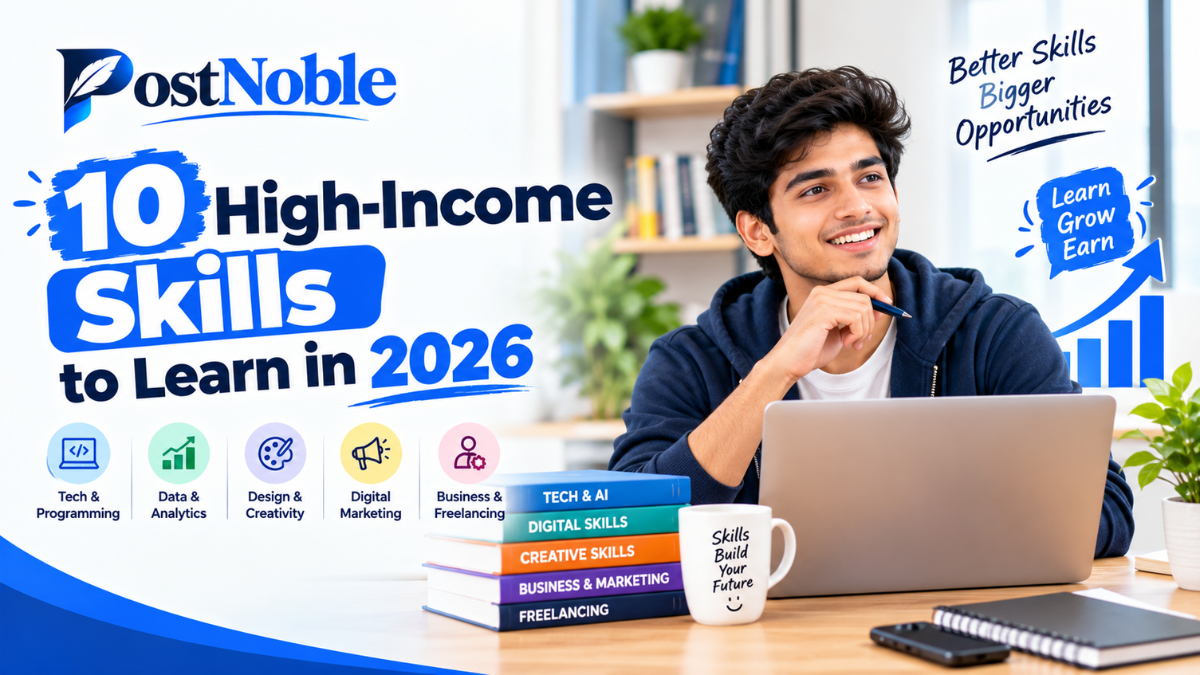
10 High-Income Skills to Learn in 2026
Career growth is changing, and high income is no longer limited to degree holders or experienced professionals. With the right skills, consistent practice, and a learning mindset, beginners can explore freelancing, remote jobs, entrepreneurship.
The way people build their careers is changing rapidly. Today, earning a good income is no longer limited to people with advanced degrees, years of experience, or traditional office jobs. With the right skills, consistent practice, and a willingness to learn, beginners can explore opportunities in freelancing, remote work, entrepreneurship, and online business.
Whether you are a student, a recent graduate, a working professional, or someone looking for a career change, learning a valuable skill can open doors to better opportunities. Businesses increasingly need people who can solve problems, communicate effectively, understand technology, and help them reach their goals.
But with so many options available, which skills are actually worth learning?
In this guide, PostNoble explores 10 high-income skills for beginners that can help you build a stronger career, find freelance clients, and potentially increase your earning opportunities. We will also explain how to get started, where these skills can be used, and how to choose the one that suits your interests.
What Are High-Income Skills?
High-income skills are specialized abilities that businesses and individuals are willing to pay for because they help solve important problems, save time, improve results, or generate revenue.
Examples include software development, digital marketing, sales, video editing, and data analysis. Unlike jobs that require a particular academic qualification, many skill-based careers allow you to demonstrate your ability through practical projects, certifications, and a portfolio.
However, learning a high-income skill does not guarantee a high salary. Your income will depend on your expertise, experience, location, industry, communication skills, and ability to deliver results.
The good news is that many of these skills can be learned through online courses, free tutorials, and hands-on practice.
10 High-Income Skills for Beginners to Learn in 2026
1. Artificial Intelligence (AI) and Automation
Artificial intelligence is changing how businesses work, from customer support and content creation to research and everyday administrative tasks. Learning to use AI tools effectively can help you become more productive and offer valuable services to clients.
You do not necessarily need to become an AI engineer to benefit from this field. Beginners can start by learning how to use AI assistants, automate repetitive tasks, organize information, and create practical workflows.
What you can learn:
- AI tools for research, writing, and productivity
- Prompt writing and evaluation
- No-code automation using workflow tools
- AI-assisted customer support and business processes
How you can earn: You could offer AI workflow setup, automation consulting, or productivity services to small businesses. More advanced learners can explore machine learning and AI engineering.
How to start: Choose a repetitive task, such as sorting customer inquiries or organizing leads, and learn how to automate it. Create a small demonstration project to show potential clients.
2. Digital Marketing
Digital marketing remains a useful skill for businesses that want to reach customers online. From local shops to large companies, organizations need ways to attract attention, generate leads, and turn visitors into customers.
This field offers several paths, so beginners can focus on one area before expanding their knowledge.
What you can learn:
- Search engine optimization (SEO)
- Social media marketing
- Email marketing
- Paid advertising
- Website analytics and conversion optimization
How you can earn: Digital marketers can work in-house, join agencies, freelance, or help businesses improve their online visibility.
How to start: Pick one channel, such as SEO or social media marketing. Build a sample campaign, practice keyword research, or help a small business improve its online content. Track results wherever possible so you can demonstrate what your work achieves.
3. Web Development
Web development is one of the most practical technical skills for people who enjoy problem-solving and building things. Businesses need websites, online stores, booking systems, landing pages, and web applications.
You can begin with basic website creation and gradually move into more advanced programming.
What you can learn:
- HTML and CSS
- JavaScript
- Responsive web design
- Front-end or back-end development
- Website performance and accessibility
How you can earn: Opportunities include freelance website projects, remote employment, agency work, and developing your own digital products.
How to start: Create a personal portfolio website, a landing page for a fictional business, and a simple interactive project. These examples can help demonstrate your abilities even if you have no professional experience.
4. Copywriting and Content Writing
Businesses need clear, engaging content to explain their products, educate customers, and encourage people to take action. That makes writing a useful skill across industries.
Copywriting focuses on persuasive content, such as advertisements, sales pages, and product descriptions. Content writing often focuses on informative material, including blog posts, guides, newsletters, and website articles.
What you can learn:
- Blog and article writing
- SEO content writing
- Sales copy and headlines
- Email newsletters
- Editing, fact-checking, and content research
How you can earn: Writers can work with blogs, marketing agencies, e-commerce companies, startups, and individual clients.
How to start: Write three to five strong samples in a specific niche, such as technology, careers, education, or personal finance. Learn how to structure articles, research reliable sources, and edit your work carefully. AI tools can support the process, but original thinking, accuracy, and a natural writing style remain important.
5. Data Analysis
Companies collect information about customers, sales, marketing campaigns, and business operations. Data analysts help turn that information into insights that support better decisions.
You do not need to begin with advanced mathematics or complicated programming. Start with spreadsheets and gradually build your technical knowledge.
What you can learn:
- Microsoft Excel or Google Sheets
- Data cleaning and organization
- SQL fundamentals
- Data visualization
- Power BI or Tableau
How you can earn: Data analysts may work in business operations, marketing, finance, logistics, healthcare administration, and technology.
How to start: Find a public dataset and use spreadsheets to identify patterns. Build a dashboard that answers a practical question, such as which products sell best or which months generate the most revenue. Document your findings in simple language.
6. Video Editing and Short-Form Content Creation
Video has become an important format for social media, online education, advertising, and entertainment. Businesses and creators often need editors who can turn raw footage into engaging videos.
Short-form videos for platforms such as Instagram Reels, YouTube Shorts, and TikTok can be a useful starting point, depending on the client's target audience and market.
What you can learn:
- Video cutting and sequencing
- Captions and subtitles
- Audio cleanup
- Color correction
- Motion graphics and storytelling
How you can earn: You can edit videos for content creators, brands, educators, marketing agencies, and small businesses.
How to start: Learn a video editor such as DaVinci Resolve, CapCut, or Adobe Premiere Pro. Create a few sample videos with different styles, including an educational clip, a promotional video, and a short social media edit. Your portfolio should show pacing, clarity, and storytelling rather than effects alone.
7. UI/UX Design
User interface (UI) and user experience (UX) design focus on how digital products look, feel, and function. A good design helps people understand a website or app and complete tasks without unnecessary confusion.
This skill combines creativity with research, problem-solving, and an understanding of human behavior.
What you can learn:
- Wireframing and prototyping
- User research
- Website and app layouts
- Design systems and accessibility
- Usability testing
How you can earn: Designers can work with software companies, startups, agencies, and businesses building digital products.
How to start: Learn Figma or another suitable design tool. Redesign a confusing checkout page or create a sample mobile app. Explain the problem you identified, the changes you made, and how the proposed design improves the user's experience.
8. Sales and Negotiation
Sales is a valuable skill because businesses need customers to survive and grow. Even if you never work as a salesperson, learning to communicate value, understand customer needs, and negotiate effectively can benefit your career.
Successful sales is not simply about convincing people to buy something. It involves listening, asking the right questions, building trust, and recommending suitable solutions.
What you can learn:
- Customer communication
- Lead qualification
- Product demonstrations
- Objection handling
- Negotiation and relationship management
How you can earn: Career options include business development, account management, software sales, recruitment, and commission-based sales roles.
How to start: Practice explaining a product's benefits, handling common questions, and conducting mock sales calls. Learn how customer relationship management (CRM) systems work and how to maintain professional follow-ups.
9. Cybersecurity
As businesses rely more heavily on digital systems, protecting information and preventing security incidents remain important concerns. Cybersecurity offers a range of career paths, although many technical positions require substantial practice and specialized knowledge.
Beginners should focus on the foundations before moving into advanced security work.
What you can learn:
- Networking fundamentals
- Operating system basics
- Identity and access management
- Security monitoring
- Vulnerability assessment in authorized lab environments
How you can earn: Potential roles include security analyst, security operations center (SOC) analyst, penetration tester, and security consultant. Entry requirements vary considerably, and some positions require formal education or certifications.
How to start: Study networking and security fundamentals, use legal cybersecurity training labs, and practice documenting findings. Never test systems without explicit authorization. Build a portfolio using controlled lab exercises rather than attempting to access real organizations' systems.
10. Cloud Computing
Cloud computing allows organizations to run applications, store data, and manage computing resources through online infrastructure. Many businesses use cloud platforms to scale their services and reduce the need to maintain all their own physical servers.
Learning cloud fundamentals can lead to opportunities in infrastructure, development, operations, and cloud security.
What you can learn:
- Cloud computing fundamentals
- Virtual machines and storage
- Networking and permissions
- Deployment and monitoring
- Basic scripting and cloud security
How you can earn: Possible career paths include cloud support associate, cloud administrator, cloud engineer, and DevOps engineer. Advanced roles usually require practical experience beyond introductory training.
How to start: Explore beginner learning resources from AWS, Microsoft Azure, or Google Cloud. Deploy a simple test application, learn how permissions work, and understand how to monitor usage and control costs. Check free-tier conditions carefully before creating resources that could generate charges.
High-Income Skills That Pay Well Without a Degree
One of the biggest misconceptions about career growth is that a university degree is the only path to a well-paying job.
In reality, some employers and clients prioritize practical ability, relevant experience, and demonstrated results. Skills such as copywriting, video editing, digital marketing, web development, and sales may offer accessible entry points for people without a degree.
However, not every employer ignores formal qualifications. Some roles, particularly in regulated fields or specialized engineering positions, may require a degree or specific credentials.
If you are learning independently, focus on three things:
- Build practical experience: Complete realistic projects rather than relying only on video tutorials.
- Create a portfolio: Show examples of what you can do and explain the results.
- Develop communication skills: Clients and employers need people who can understand requirements, meet deadlines, and solve problems professionally.
Your goal should be to prove that you can deliver useful work, not simply collect certificates.
Best Skills to Learn in 2026 to Earn Money Online
Looking ahead to 2026, the best skill to learn will depend on your interests, existing knowledge, and the needs of your target market. Rather than chasing every new trend, consider skills that can adapt as technology and business priorities change.
Some promising areas to explore include:
- AI and business automation: Helping organizations use AI tools responsibly and improve everyday workflows.
- SEO and digital marketing: Helping businesses reach relevant audiences and measure marketing performance.
- Data analysis: Turning business information into understandable insights.
- Software and web development: Building, maintaining, and improving digital products.
- Cybersecurity and cloud computing: Supporting the reliability and protection of digital infrastructure.
- Video production and content strategy: Helping brands communicate through useful, engaging content.
These are areas worth investigating, not guarantees of future earnings. Demand differs by country, industry, experience level, and the specific services you offer.
A practical approach is to learn one core skill and combine it with a complementary ability. For example, a web developer who understands SEO may offer more complete website services, while a video editor who understands content strategy can help clients make videos with a clearer purpose.
How to Choose the Right High-Income Skill for You
With ten options available, choosing one can feel overwhelming. The best choice is not necessarily the skill with the most attention online. It is the skill you can realistically learn, practice, and use to solve a problem people are willing to pay for.
Consider these questions:
Do you enjoy creative work? Content writing, video editing, UI/UX design, and digital marketing may be worth exploring.
Do you like technology and problem-solving? Web development, AI automation, data analysis, cybersecurity, and cloud computing could suit you.
Are you comfortable communicating with people? Sales, marketing, and client-facing freelance work may be a good fit.
Do you need to start with a limited budget? Begin with free learning resources and accessible tools. Writing, basic SEO, spreadsheet analysis, and introductory web development can often be practiced without expensive equipment.
How much time can you commit? Choose a learning path that fits your schedule. Consistent practice over several months is generally more useful than trying to master several unrelated skills at once.
A Simple 90-Day Plan to Start Learning a High-Income Skill
You do not need a perfect plan to begin. A simple structure can help you move from learning to practical experience.
Days 1–30: Learn the fundamentals
Choose one skill and study its core concepts. Follow a structured beginner course, take notes, and practice regularly. Avoid switching between different skills every few days.
Days 31–60: Build real projects
Create two or three projects that demonstrate your ability. For example, write SEO-friendly articles, develop a sample website, edit short videos, or build a data dashboard.
Days 61–90: Build your portfolio and find opportunities
Organize your best work in a simple portfolio. Update your CV or professional profile, contact relevant businesses, apply for entry-level jobs, or explore freelance platforms. Ask for feedback and improve your work based on what you learn.
Your first project or client may take time to find. Treat rejection as feedback, keep improving your skills, and avoid spending money on expensive courses before understanding what you actually need.
Final Thoughts
Learning a high-income skill can be a practical step toward better career opportunities, greater flexibility, or a new source of income. However, success rarely comes from choosing a popular skill alone. It comes from developing real ability, solving meaningful problems, communicating well, and continuing to improve.
Start with one skill that matches your interests and goals. Learn the fundamentals, build projects, and look for opportunities to apply what you know. As you gain experience, you can specialize, expand your services, or combine your skills to stand out in the market.
At PostNoble, we believe that informed decisions and consistent learning are valuable foundations for professional growth. You do not need to learn everything at once. Choose your starting point, take the first step, and build from there.