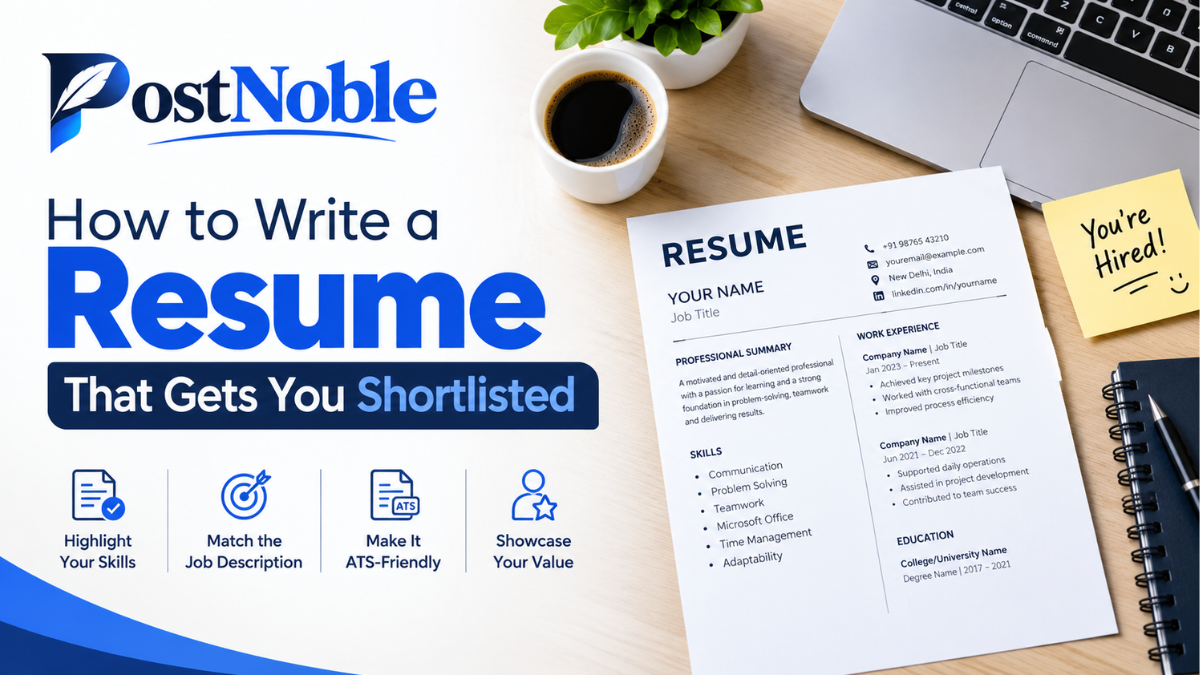
How to Write a Resume That Gets You Shortlisted
However, getting the right job is not an easy task at all, and in most cases, especially where several people vie for the same job opening, the challenge might be tough despite having the necessary qualification for the job.
It might happen because your resume fails to capture the recruiter’s attention within the short period available for consideration.
However, on the bright side, crafting an effective resume is not very difficult at all. If you manage to create the right structure and use the appropriate keywords along with the description of your accomplishments, then you will make things easy for recruiters.
This resume guide by PostNoble is meant for helping one get some advice on how to craft his/her resume in order to be distinguished from the rest by potential employers.
Whether you are a fresher searching for your first employment opportunity or an experienced professional looking to change jobs, these suggestions will help you craft a CV that emphasizes all your strong points.
What Is a Resume and Why Is It Important?
A resume is a piece of paper which contains all your academic and professional credentials. The main purpose of writing a resume is to prove yourself eligible for a particular job position in front of the employer.
The resume is the impression made before meeting an employer in person during an interview. The recruiter will first look at the resume before he or she meets the candidate personally.
A well-written resume can help you:
- Highlight your most relevant skills and experience.
- Demonstrate your suitability for a specific position.
- Make a positive first impression on recruiters.
- Pass initial screening by applicant tracking systems (ATS).
- Increase your chances of receiving an interview invitation.
But, having a resume doesn’t imply that you will be short-listed. The needs of the employer are very different from yours. It is necessary that you try and make your resume as relevant and impressive as possible.
1. Understand the Job Description Before Writing Your Resume
The best advice about resume writing would be that a person should know the requirements of the job first before making a resume.
It happens very often when people send resumes for every kind of job opening without thinking about anything else. It takes less time for people to do so.
Firstly, go through the job description to ascertain the requirements that the potential employer needs.
For example, when someone is looking for a job as a digital marketer, he or she will be able to see certain things like SEO, keywords, Google analytics, and campaigns.
Assuming that you actually have experience in the mentioned skills, make sure to highlight them in the appropriate areas of your resume.
What you should do:
- Identify the top requirements from the job description.
- Find out the requirements that you have the necessary skills for.
- Focus on experience and accomplishments.
- Delete information that is not pertinent to your application.
- Tailor your resume for each important job application.
This approach helps recruiters quickly understand why your profile is relevant to their vacancy.
2. Choose the Right Resume Format
The way you structure your CV determines how easy it will be for the recruiter to access the vital information. The way you organize it ensures clarity.
There are three common resume formats.
Reverse-Chronological Resume
In this case, you start with your latest work experience and move down through the others in reverse chronological order. This format works well for people with steady career development.
Functional Resume
It is a resume which focuses on skills of the applicant rather than job history. It is helpful for applicants who want to demonstrate their transferable skills but recruiters prefer job history at times.
Combination Resume
This format enables a combination of skills and work experience sections. It would be useful for candidates who need to highlight both their skills and work experience.
For most job seekers, the standard reverse chronological format is a good beginning.
Keep design professional. Make sure fonts are readable, headings are used correctly, there is enough white space and use bullets. No unnecessary graphics, tables, or other adornments should be used which might interfere with the scanning or understanding of the document.
3. Write a Strong Resume Summary
The resume summary is found in the upper part of the page right under the contact information section. This is where you will make an introduction of yourself to the employer.
A good summary should be concise, specific, and tailored to the job.
Avoid generic statements such as:
"Hard working and dedicated professional who is in search of a challenging position to enhance his skills."
This statement could describe almost any applicant. It does not explain what you can offer the employer.
A more effective example for a digital marketing professional would be:
"Digital marketer who is proficient in SEO, keyword research, content optimization, and performance analytics. Skilled in content strategy formulation and improving search engine visibility."
Freshers can also write an effective summary without professional experience.
For example:
"A self-motivated individual who is experienced in digital marketing, SEO, content writing and keyword research. Highly enthusiastic to apply research skills, communication skills and analysis in an entry-level marketing job role."
Apply your true qualifications and experiences to these examples. Do not include any skills and achievements that you cannot prove.
4. Highlight Relevant Work Experience and Achievements
In the part of your work experience, one must describe what you have done, what your responsibilities were, and what your achievements were.
It can be that case that just listing your activities will not show enough what an important contribution you have made. Always try to share some information about your achievements, where possible.
For example, instead of writing:
- Responsible for website content.
- I worked on SEO activities.
- Managed social media accounts.
You could write:
- Published and optimized website articles using relevant keywords and on-page SEO practices.
- Conducted keyword research to identify content opportunities and improve search relevance.
- Managed social media content calendars to support consistent brand communication.
In case you have information regarding your performance, use it in your resume. You can state that you have raised the number of organic visits to the site by 25 percent within six months.
Use this simple formula: Action + Task + Result.
For instance, "Performed optimization of 20 articles on blogs with keyword research and on-page SEO, which helped improve their organic visibility."
Every task does not require numbering. Descriptions of tasks that have meaning are superior to made-up numbers.
Focus on experience that directly relates to the position you want.
5. How to Make a Resume for Freshers With No Experience
Even during the process of seeking your first employment opportunity, there is an understanding that your CV will lack content without having had some work experience in the past. However, your academic background, projects, internships, and certifications can also be assessed.
The key is to demonstrate your potential through relevant evidence.
Include these sections in your fresher resume:
- Contact information: Your name, phone number, professional email address, and relevant portfolio or LinkedIn profile.
- Career objective or summary: A short introduction describing your relevant interests and strengths.
- Education: Your degree, institution, graduation year, and relevant academic achievements.
- Skills: Technical and interpersonal skills that match the job description.
- Projects: Academic assignments, personal projects, or practical work demonstrating your abilities.
- Internships or volunteering: Any relevant experience that shows responsibility and teamwork.
- Certifications: Relevant courses or professional training you have completed.
Example: An individual who wants to apply for the content writing job can mention his/her own blog, writing samples, keyword research work, or writing projects.
The person who is looking for the position in software development can highlight his/her coding experience, portfolio on Github, and academic projects.
There is no need to feel sorry for the lack of experience. On the contrary, highlight your skills and what you are able to do.
6. Create an ATS-Friendly Resume for Job Applications
These applicant tracking systems (ATS) are typically used by many firms to collect, process, and screen applications. This is because an ATS resume is drafted in a manner that it makes it easier for the software to identify key details.
A resume friendly to ATS consists of appropriate formatting and language usage, making the important details easily recognizable.
Follow these practices:
Use Standard Section Headings
Select popular headings such as “Experience,” “Education,” “Skills,” and “Professional Certifications.” While it may seem attractive to select creative headings, they may sometimes make the task of comprehending the information difficult.
Include Relevant Keywords Naturally
If you have experience in work that is relevant to project management, data analysis, and customer relationship management, include the key words in your resume as defined in the job description.
Do not load your resume with repetitive keywords. It must retain its meaning.
Keep the Layout Simple
It is highly recommended that single column design be employed whenever possible. The inclusion of contact details in the header or footer is not advised. Icons, graphics, text blocks, and tables should be limited.
Choose an Appropriate File Format
Follow the instructions from your employer in terms of formatting. When there are no instructions regarding formatting, it is preferable to use the text PDF format since it preserves the formatting, and Word can also be used.
Check Readability
Before submitting your resume, copy the text of the resume into a new document and determine if the text makes sense in a logical progression of thoughts. This is an easy technique, but it does not necessarily mean your resume is ATS-compliant.
However, do not forget that various employers have different procedures for ATS screening. There is no standard resume format that guarantees your selection.
7. Add the Right Skills to Your Resume
The list of your abilities must depend on the requirements of the job you are applying for. Too many unnecessary abilities on your resume can suggest that you have no focus.
Most resumes benefit from a combination of technical skills and transferable skills.
Technical skills are abilities related to a particular role. Examples include:
- SEO and keyword research
- Microsoft Excel and data analysis
- Programming languages
- Graphic design software
- Financial reporting
- Customer relationship management tools
Transferable skills are useful across different professions. Examples include:
- Written communication
- Problem-solving
- Time management
- Teamwork
- Organization
- Critical thinking
Focus on the skills that can be used in relation to this particular job position. Provide examples of how you used them in practice in your previous work and studying experiences.
Do not mention any technology that was mentioned in the job description just for the sake of it. Mention only those skills that you have and can easily discuss at your interview.
8. Keep Your Resume Concise and Easy to Read
The main job of a recruiter is that he/she should be able to recognize important information quickly; otherwise, when a resume contains long paragraphs and irrelevant experience, it would become difficult for the recruiter.
A one-page resume will be sufficient for many young job seekers, but a two-page resume will be necessary for seasoned professionals.
Use these guidelines to improve readability:
- Keep bullet points short and focused.
- Use consistent font sizes and spacing.
- Place your most relevant information near the top.
- Avoid unnecessary personal details.
- Use bold formatting selectively for job titles or important headings.
- Remove outdated or irrelevant information.
For example, there is little necessity to list all the subjects you studied at school, since having a certificate and certain experience can help you avoid it. Similarly, your hobbies should be mentioned when they work to your advantage.
Your CV does not have to contain everything that you have ever done; it has to contain what helps your case.
9. Include Accurate Contact Information and Professional Links
Even a strong resume can lose its value if recruiters cannot contact you.
Write your personal contact information on top of the document. These should consist of your full name, phone number, professional email, and your location.
LinkedIn profile or other professional website can also be included if it adds value to your application.
Before submitting your resume, check that:
- Your phone number is correct.
- Your email address is professional and active.
- Your links open successfully.
- Your portfolio contains relevant work.
- Your LinkedIn profile is reasonably consistent with your resume.
Most of the time, there is no need for you to give any other information except your complete physical address, your government identification numbers, your marital status, and other unnecessary details. Always follow the legitimate instructions from your employer.
10. Proofread Your Resume Before Applying
Even one small error can divert the attention of the recruiter from your qualification. Spelling errors, incorrect dates, problems in format, and broken links can make a well-formatted resume look unprofessional.
Take some time to go through the resume once before submitting.
Review your resume from start to finish. Look out for the correct job titles, company names, dates, spelling, grammar, and punctuation. Furthermore, make sure that your bullet points match your experiences.
You can request one of your friends or co-workers to read through the resume too. A new reader will help you catch all those statements and information you might have missed out on.
Finally, give the name to the file in such a manner that it reflects your complete name and objective of the resume. An example is "Aarav_Kumar_Marketing_Resume.pdf."
In summary, the final review will provide you with an assurance that your resume is factual, relevant, and well-written for submission.
Common Resume Writing Mistakes to Avoid
Even qualified candidates can weaken their applications through avoidable mistakes. Watch out for these common problems:
Using the same resume for every job: Tailor your summary, skills, and experience to each relevant vacancy.
Adding too much information: Remove details that do not support your current career goal.
Using vague descriptions: Replace generic statements with specific responsibilities and achievements.
Exaggerating qualifications: Be honest about your experience, skill level, and results.
Ignoring ATS readability: Use standard headings, simple formatting, and relevant keywords.
Including an unprofessional email address: Choose an email address based on your name or a professional variation.
Forgetting to proofread: Check spelling, grammar, dates, contact details, and document formatting before submitting.
Avoiding these mistakes will help you present a more polished and credible professional profile.
Final Resume Checklist Before You Apply
Before sending your next application, use this checklist to review your resume.
- My resume matches the job description.
- My contact information is accurate.
- My summary clearly communicates my strengths.
- My skills and experience are relevant to the position.
- My achievements are specific and truthful.
- My resume uses clear headings and readable formatting.
- My keywords appear naturally throughout the document.
- My spelling, grammar, and dates are correct.
- My portfolio and professional links work.
- My document follows the employer's file and submission requirements.
Completing these checks can help you avoid common errors and submit a stronger application.
Conclusion
A resume which ensures that one gets shortlisted for job vacancies cannot be considered complete by just choosing an attractive resume format alone. It needs one to present the right information in the right way.
Start with knowing about the job, choosing the format for your CV, and creating a professional summary. Apply your achievements, prove your skills using real-life examples, and apply natural keywords in order to increase the readability of your CV as well as its effectiveness from the point of view of the ATS. If you are a fresher, stress on your education, projects, and certification rather than work experience.
Most importantly, customize your resume for the position you want and ensure every detail is accurate.
According to PostNoble, appropriate career counseling will help the applicants gain confidence while applying for positions. These resume writing techniques should be used while applying for your next job. Your resume will keep evolving as per your experience. Whenever you apply for a job, remember to highlight your worth as a professional.