Top 15 Interview Questions and Answers for Freshers
Your first job interview can feel daunting, but you don’t need extensive professional experience to impress an interviewer. With confidence, preparation, and clear answers, you can make a strong first impression.
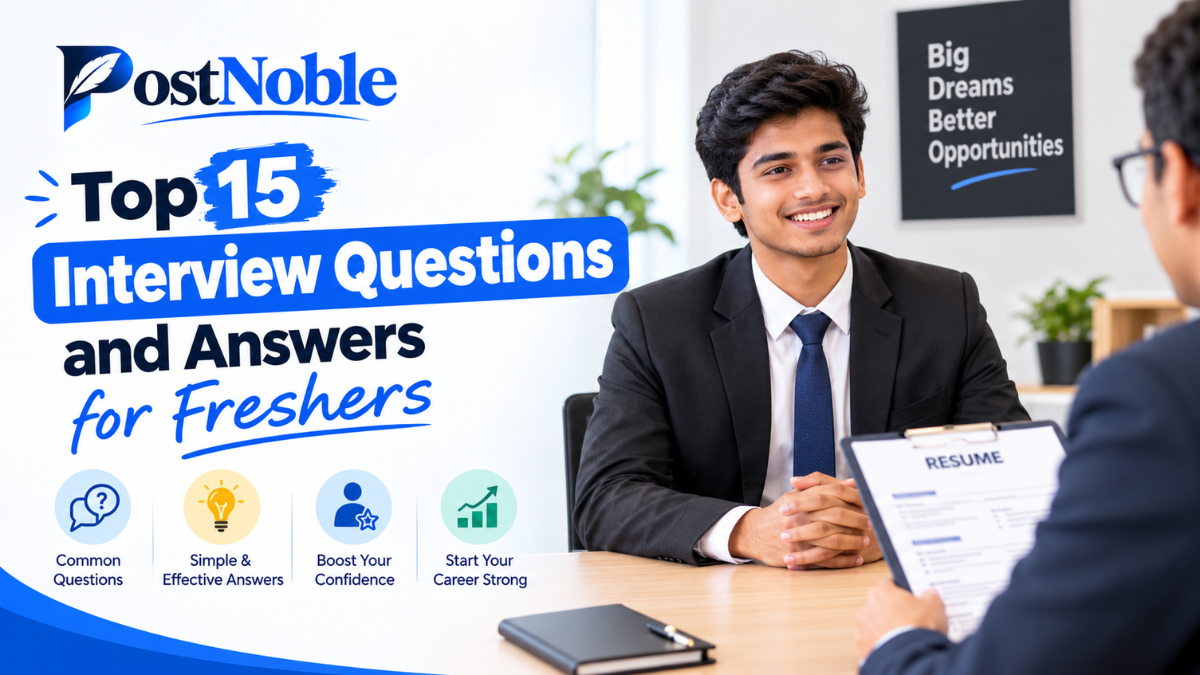
Entering the workforce is an incredible achievement for any individual; however, taking part in your first ever job interview could be quite daunting for you. It is possible for you to worry about how you are going to be questioned by the interviewer and how to respond with conviction, especially considering that you might not possess any professional experience. However, it is important to keep in mind that it is not necessary for one to have lots of professional experience in order to impress an interviewer.
It is always a great idea to be ready for the top 15 interview questions and answers for freshers. Employers always wish to know about your personality, communication skills, education, ability to solve problems, and whether you are interested in the position offered to you or not. They also wish to know whether you are motivated enough to work with them.
PostNoble believes that each fresher should be given an opportunity to prove his/her caliber. This guide will help you know the 15 most frequently asked interview questions for freshers along with answers and preparation tips for your next interview.
Why Is Interview Preparation Important for Freshers?
Through interview preparation, you will be able to structure your ideas, showcase your skills, and feel comfortable answering any type of questions. Even if you are doing great in your academics, being able to articulate your skills and knowledge is extremely important.
The recruiters recruiting freshers give importance to transferable skills like team work, communication skills, time management, creativity, and learning. You can give illustrations from your academics projects, internships, college activities, volunteering, and personal projects.
Instead of learning the answers verbatim, know why the questions are asked and how to answer them naturally. This will make your speech seem more genuine.
Top 15 Interview Questions and Answers for Freshers
The following are 15 common job interview questions for freshers and their answers, which you can tailor to yourself according to the job that you seek.
1. Tell Me About Yourself.
This is one of the frequently asked interview questions among freshers. In response to this question, you have to give an introduction which includes your educational qualifications and other things.
Sample answer:
"Thanks for providing me with this opportunity. My name is [Your Name], and I have just graduated in [Your Degree] from [Your College/University]. During my course of study, I have taken a keen interest in [Your Field of Interest] and have acquired knowledge of [Your Relevant Skills]. Also, I was involved in academic projects which improved my problem-solving skills as well as teamwork. Now I am seeking a chance to put my knowledge into practice."
Tip: Keep your introduction around 45–60 seconds. Focus on information relevant to the job instead of sharing your entire personal history.
2. Why Should We Hire You?
This question allows you to explain what makes you a suitable candidate, even if you have limited professional experience.
Sample answer:
"As a fresher, I have an enthusiastic desire to learn and a positive approach to everything along with the ability to perform responsibilities. My educational experience has provided me with the basics of [Relevant Subject or Skill]. I have no problem working with other people and learning from feedbacks to improve my performance. Although I am just starting out, I am prepared to work hard to gain skills that will help me be a valuable addition to your team."
Tip: Connect your strengths to the job description. Avoid claiming skills or achievements you cannot demonstrate.
3. What Are Your Strengths?
Employers ask this question to understand which qualities could help you succeed in the role.
Sample answer:
One of my primary strengths is my readiness to acquire new knowledge. Besides that, I am an organized person who tries to handle time management. While doing projects at the university, I gained experience in working together with other team members, accomplishing given tasks, and dealing with any arising problems. I think that these qualities will suit me well in a professional environment."
Tip: Choose two or three genuine strengths and support at least one with a specific example from your studies, projects, or extracurricular activities.
4. What Is Your Biggest Weakness?
Interviewers want to see whether you understand your areas for improvement and are taking steps to address them.
Sample answer:
"As for me, previously, there were times when I was hesitant about expressing myself while contributing to group discussions. Realizing how essential it is to communicate well, I started becoming a participant in presentations and teamwork at university. I am learning to feel confident about expressing my ideas."
Tip: Choose a genuine but manageable weakness. Explain what you are doing to improve rather than presenting a weakness disguised as a strength.
5. Why Do You Want to Work With Our Company?
This question measures how much you know about the employer and whether your interests align with the role.
Sample answer:
"I am interested in joining your company due to your involvement in [Industry or Business Area] and the duties that have been stated in the job description. The position will give me the opportunity to utilize my prior knowledge and develop practical skills at the same time. I am also eager to learn from experienced team members and contribute to important projects."
Tip: Research the company's products, services, values, and recent developments before the interview. Mention a specific reason for your interest.
6. What Do You Know About Our Company?
Employers want to know whether you have researched the organization before applying.
Sample answer:
"From my research, I have understood that your firm is into [Industry] and offers [Main Products/Services]. I have further come to know that your role entails [Relevant Responsibilities]. I am highly interested in working in this field since it is in sync with my interest and the skill development areas I would like to explore."
Tip: Check the company's official website, careers page, and professional social media profiles. Make sure your information is accurate and up to date.
7. Where Do You See Yourself in Five Years?
This question helps the interviewer understand your ambitions and whether you have a realistic approach to career development.
Sample answer:
"In the next five years, I would want to have become an efficient professional in my chosen field, being aware of my duties and having the capability to carry out difficult jobs on my own. I want to keep on learning and taking up more responsibilities and contributing to the organization."
Tip: Show ambition while keeping your answer realistic. You do not need to predict every detail of your future career.
8. Why Did You Choose This Career?
The interviewer wants to understand your motivation and interest in the field.
Sample answer:
"This is what I have chosen for my future career as I have interest in [Your Field] and like to learn about [Relevant Topic or Activity]. While studying I became very much interested in [Specific Subject, Project, or Experience]. It made me learn more about this field and gain some necessary skills. Now I want to apply my interest practically."
Tip: Connect your education, personal interests, or projects to the position. A genuine explanation is more convincing than a generic answer.
9. Do You Have Any Work Experience?
Freshers are often concerned about this question, but employers understand that entry-level candidates may not have held full-time jobs.
Sample answer:
"As a fresher, I have not acquired any formal full-time working experience so far. Nonetheless, I have been able to acquire some skills from my educational assignments and projects. For instance, I did [Project or Assignment], whereby I gained knowledge in [Skill]. I am very much keen on building on this experience."
Tip: Be honest about your experience. If you have completed an internship, freelance assignment, volunteering activity, or relevant personal project, explain what you learned from it.
10. How Do You Handle Pressure or Tight Deadlines?
Employers want to know whether you can stay organized and work effectively when several tasks need attention.
Sample answer:
"If I have several jobs that need doing, I first decide which ones are more urgent and set them down along with the deadline for each. I then break down large jobs into smaller ones and do them one after another. When writing assignments in college, this strategy has proved effective in helping me handle my work without confusion at the last minute."
Tip: Describe a practical method you use to manage pressure. If possible, support your answer with an example.
11. Are You Comfortable Working in a Team?
Teamwork is important in many entry-level roles because employees often collaborate with colleagues from different backgrounds.
Sample answer:
"Yes, as a matter of fact, I do like working in groups as it allows everybody the chance to exchange their ideas with each other. While doing a project at college, my colleagues and I divided the tasks among ourselves. While we talked about the various ways of doing things, we cooperated with each other in completing our assignment."
Tip: Use a real example that demonstrates how you contributed to a shared goal. Teamwork also means listening, respecting different opinions, and accepting responsibility.
12. What Are Your Salary Expectations?
Salary questions can be challenging for freshers, particularly when they have limited knowledge of industry pay ranges.
Sample answer:
"As a fresh graduate, my first objective would be to land a job in which I can utilize my skills and gain experience. I am flexible with regards to the salary negotiation process based on the duties of the job, the remuneration package of the organization, and the industry norms."
Tip: Research typical salaries for similar entry-level positions in your location. If the employer provides a salary range, consider whether it aligns with your expectations before responding.
13. How Do You Handle Feedback and Criticism?
Employers value candidates who can accept constructive feedback and use it to improve their performance.
Sample answer:
"For me, feedback is always a learning process. When someone tells me that there is something that needs improvement in me, I listen to it, ask questions if anything is not clear, and try my best to improve myself in the required areas. Through my academic life, feedback from my teachers and peers helped me to improve my work."
Tip: Demonstrate openness to learning without suggesting that you never make mistakes. Employers appreciate candidates who take feedback seriously.
14. What Motivates You to Do Your Best Work?
This question helps employers understand what encourages you to stay engaged and perform well.
Sample answer:
"I feel motivated through chances to learn, solve problems, and achieve something through my work. It is good for me to have a goal and improve my skills. When I am done with a hard task or learn a new thing, it motivates me. As a professional, I would find motivation in helping the team and developing my skills."
Tip: Focus on genuine motivators, such as learning, problem-solving, meaningful work, collaboration, or achieving measurable goals.
15. Do You Have Any Questions for Us?
This question often comes near the end of an interview. Asking thoughtful questions shows that you are interested in the position and want to understand the role.
Sample answer:
"Thank you. Yes. Can you please tell me how the first few months of being in this position would be for someone? Which skills and qualities will help an individual perform well in this position? I am also eager to know what kind of training and development programs can be found here for freshers?"
Tip: Prepare two or three questions in advance. Avoid asking questions whose answers are already clearly explained in the job description or on the company's website.
Best Interview Preparation Tips for Freshers
Knowledge of the answers to the most frequently asked interview questions for freshers would be a good starting point, but preparing yourself goes beyond just answering sample questions. The following tips might be useful.
1. Research the Company and Job Role
Study the job description closely and note down the competencies that are emphasized by the employer. Study the background of the organization, its products and customers, and its working environment. This will assist you in formulating relevant questions.
2. Practice Your Answers Out Loud
Answering questions in silence is not going to help you answer the questions when you have to address an interviewer. Practice answering aloud; you could even do so in a recorded format and see if your answers are concise.
3. Prepare Examples From Your Education
You don’t have to be a professional in order to showcase your abilities. Projects and assignments completed at school, internships, volunteer work, etc. can assist you in doing that.
Use the STAR method for questions about past experiences:
- Situation: Explain the background.
- Task: Describe what needed to be done.
- Action: Explain what you personally did.
- Result: Share the outcome or what you learned.
4. Dress Professionally and Arrive on Time
It is important to wear proper attire and to schedule your travel beforehand for the face-to-face interview. In case of telephonic interviews, it is essential to ensure the connection and other equipment well before the interview.
5. Communicate Honestly and Confidently
Speak with clarity, listen to the whole question and allow yourself some time to think before responding if you need to do so. If you don’t know the answer to a question, be honest about this and say how you would go about finding out.
6. Follow Up After the Interview
If applicable, send a short email thank you message after the interview is completed. Let the interviewer know that you appreciate the opportunity and briefly restate your desire to work in the position. Be professional and do not contact the recruiter persistently.
Common Interview Mistakes Freshers Should Avoid
Even well-prepared candidates can make mistakes that affect their interview performance. Keep these points in mind:
- Memorizing every answer: Over-rehearsed responses can sound unnatural. Understand the key points and speak in your own words.
- Giving unnecessarily long answers: Stay focused on the question and include relevant examples.
- Speaking negatively about others: Avoid criticizing teachers, classmates, previous employers, or other candidates.
- Exaggerating your skills: Be honest about what you know and what you are still learning.
- Ignoring the job description: Your answers should demonstrate why your skills and interests are relevant to the position.
- Forgetting to ask questions: Prepare thoughtful questions that help you understand the role and the team.
Avoiding these mistakes can help you present yourself as a thoughtful, professional, and motivated candidate.
Conclusion
Being ready with the top 15 interview questions and answers for freshers will definitely increase your level of confidence for your first job interview experience. You get a chance to showcase your abilities by answering each one of these questions, whether it is about yourself or your career goals.
Keep in mind that the employers would never expect every fresher to know everything, nor would they expect any sort of professional experience from them. All they expect from you is to be able to communicate effectively and show eagerness in learning new things.
Take the sample answers from this guide as a template, add your personal touch to them, and speak fluently. Study the firm and think of examples, and make sure that you treat each interview as a learning process.
Our aim at PostNoble is to assist the job seeker in making a career decision and acquiring essential skills needed for success in the workplace. With adequate preparation and the correct attitude, you will be taking a vital step towards landing your first job and career success.
Frequently Asked Questions (FAQs)
1. What are the most common interview questions for freshers?
Common questions include "Tell me about yourself," "Why should we hire you?", "What are your strengths and weaknesses?", "Why do you want to work here?", and "Where do you see yourself in five years?"
2. How should a fresher prepare for a job interview?
Research the company, review the job description, practice common interview questions, prepare examples from academic projects, and rehearse your introduction. Also, plan your interview logistics and prepare questions for the interviewer.
3. How can I answer interview questions without work experience?
Use examples from college projects, internships, coursework, volunteering, extracurricular activities, and personal projects. Explain your contribution, the skills you developed, and what you learned.
4. How long should a fresher's interview answers be?
Most general answers should take around 30–90 seconds, depending on the question. Your introduction can be around 45–60 seconds, while questions about specific projects may require more detail.
5. Can I get a job as a fresher without experience?
Yes. Many organizations recruit entry-level candidates and provide training. Relevant skills, academic knowledge, communication, practical projects, and a willingness to learn can help you demonstrate your suitability for a position.