
AI in Gaming: How Artificial Intelligence Is Changing Online Games
Explore how AI in gaming is transforming online games with smarter characters, realistic gameplay, personalized experiences, and innovative technologies shaping the future of artificial intelligence in video games.
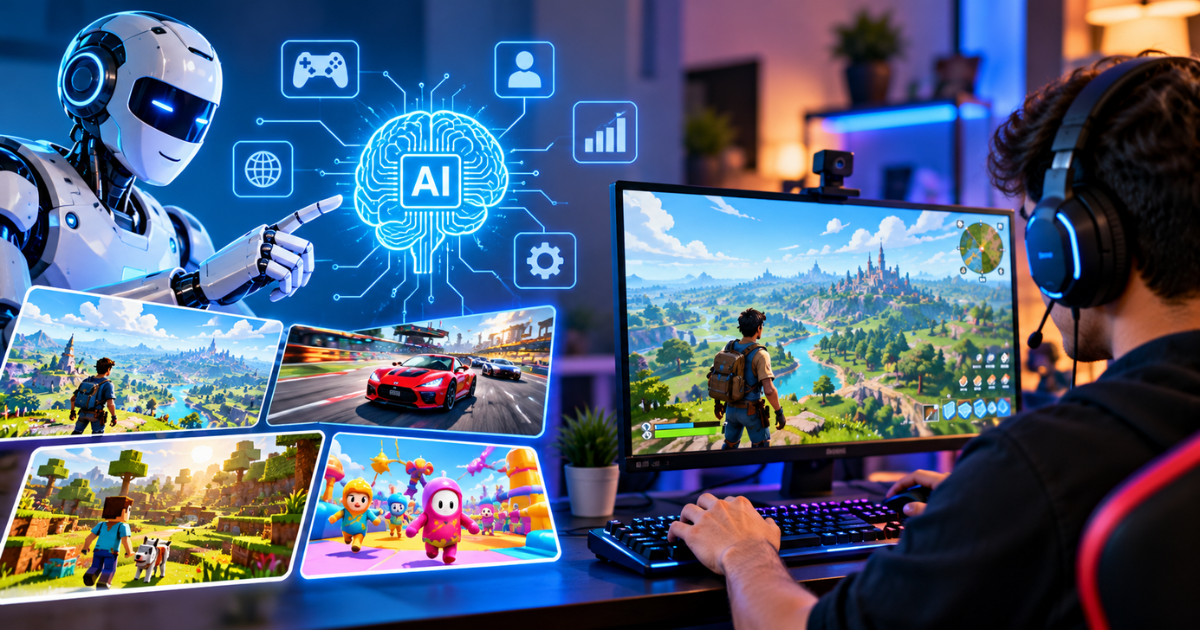
Online gaming has changed significantly over the past few years. Games are no longer limited to fixed rules, predictable computer-controlled opponents, or repetitive missions. Today, developers are using advanced technologies to create more realistic characters, smarter challenges, personalized experiences, and interactive virtual worlds. One of the biggest forces behind this transformation is artificial intelligence (AI).
AI in gaming is changing how players explore virtual environments, compete against opponents, complete missions, and interact with other characters. From intelligent non-player characters (NPCs) to adaptive difficulty systems, AI is helping developers create games that feel more responsive and engaging.
For beginners and experienced players alike, these developments are making online gaming more dynamic. In this guide, PostNoble explores how artificial intelligence is transforming online games, the major benefits it offers, and the AI gaming trends that could shape the future of the gaming industry.
What Is AI in Gaming?
AI in gaming refers to the use of artificial intelligence technologies to make games more responsive, intelligent, and interactive. These systems allow computer-controlled characters and game environments to respond to player actions rather than following only simple, predefined instructions.
For example, an enemy in a strategy game might change its approach when a player repeatedly uses the same tactic. Similarly, a racing game may feature opponents that adjust their driving decisions according to the player's movements.
Artificial intelligence can also help developers analyze gameplay patterns, improve testing processes, and generate certain elements of virtual worlds.
However, not every intelligent-looking game feature uses modern AI. Many traditional games rely on rule-based programming, while newer systems may incorporate machine learning, natural language processing, or generative AI.
The goal is straightforward: create gaming experiences that feel more engaging, challenging, and natural.
7 Ways Artificial Intelligence Is Changing Online Games
Artificial intelligence is influencing several parts of game development and gameplay. Here are seven important ways it is changing the online gaming experience.
1. Smarter Non-Player Characters
Non-player characters, commonly called NPCs, are characters controlled by the game rather than by human players. They might be shopkeepers, teammates, enemies, quest givers, or supporting characters.
Traditionally, NPCs followed limited dialogue options and predictable behavior patterns. Modern AI techniques can make these characters more responsive to different situations.
For example, an NPC in an adventure game might react differently depending on the player's previous choices. An enemy could attempt to find cover, change its attack strategy, or respond to the player's position.
In future games, generative AI may also allow characters to hold more flexible conversations rather than repeating the same dialogue.
These developments can make virtual worlds feel more believable. However, the quality of NPC behavior still depends on how well developers design and control the underlying systems.
2. Personalized Gaming Experiences
Every player has a different skill level, preferred playstyle, and approach to challenges. Artificial intelligence can help developers create experiences that better match these differences.
For example, a game might recognize that a beginner is struggling with a particular mission and provide additional guidance. More experienced players could encounter tougher opponents or more complicated objectives.
Personalization can also involve recommending game modes, suggesting suitable challenges, or adjusting certain gameplay elements.
This approach can make games more welcoming to newcomers without removing the challenge that experienced players enjoy.
However, personalization should be implemented carefully. Players should retain meaningful control over their experience, and developers should avoid using behavioral data in ways that feel intrusive.
3. More Realistic Multiplayer Opponents
Online multiplayer games are popular because they allow people to compete, cooperate, and communicate with others. However, finding suitable opponents is not always easy, particularly in less active game modes or at unusual hours.
AI-controlled opponents can help fill certain gaps by providing practice matches, training opportunities, or alternative gameplay options.
For example, a beginner learning a competitive shooter could practice against computer-controlled opponents before joining a match against experienced players. A sports game might also use AI-controlled teammates to support offline or mixed-player modes.
These systems can make games more accessible and provide useful opportunities to improve skills.
Still, AI opponents are not a complete replacement for human competition. Human players bring unpredictable decisions, creativity, and social interaction that automated systems may struggle to reproduce.
4. Dynamic Game Worlds and Storylines
One of the most exciting developments in artificial intelligence in video games is the potential to create more responsive worlds.
In traditional games, many events follow a fixed sequence. Players may complete missions in different orders, but the major storyline often remains the same.
AI-powered systems can help developers introduce more variation through changing environments, reactive characters, and branching interactions.
Imagine an adventure game in which the player's decisions influence how different communities respond. Helping one character might unlock a new mission, while ignoring a developing problem could change the available options later.
AI-assisted tools may also help developers generate dialogue variations, environmental details, or mission ideas.
These possibilities could increase replay value by giving players more reasons to explore different choices. Nevertheless, human designers remain important for maintaining narrative quality, consistency, and meaningful consequences.
5. Better Game Development and Testing
AI is not only changing what players experience. It is also changing how games are created.
Developing an online game requires substantial work, including designing environments, writing code, testing mechanics, identifying bugs, and balancing gameplay. AI tools can help with several of these tasks.
For instance, automated agents can test levels repeatedly, explore different routes, and identify situations that human testers might overlook. AI-assisted coding tools can help developers review code or investigate certain technical problems.
Generative tools may also support early concept development, placeholder assets, and dialogue drafts.
These applications can reduce repetitive work and allow development teams to spend more time refining important features.
However, AI-generated material still requires human review. Developers must check for technical errors, copyright concerns, inconsistent design, and other quality issues before using it in a finished game.
6. Improved Game Security and Fair Play
Fair competition is essential for the long-term success of online gaming. Cheating, suspicious account activity, and automated bots can damage the experience for legitimate players.
AI-assisted detection systems can analyze gameplay patterns and flag activity that may require further investigation.
For example, a security system might identify unusual input patterns, suspicious match behavior, or activity that differs significantly from typical player behavior.
Machine learning can also help developers identify emerging patterns that traditional detection methods may miss.
However, automated detection is not always accurate. Highly skilled players may perform unusually well without cheating, and unusual network conditions can affect gameplay statistics.
For this reason, AI should support a broader security process rather than automatically determine every punishment. Human review, clear rules, and opportunities to appeal decisions remain important.
7. More Natural Communication and Accessibility
Communication plays a major role in multiplayer games, especially when players need to coordinate strategies or complete team objectives.
AI-powered speech recognition and language tools can support features such as automatic captions, translated chat, voice commands, and communication assistance.
These features may help players communicate across language barriers or participate more comfortably when they have different accessibility needs.
For example, real-time captions can make spoken instructions easier to follow. Translation tools may help international teams coordinate without relying on a shared first language.
AI can also support alternative control methods and personalized assistance in some games.
When these features are designed thoughtfully, they can make online gaming more inclusive and convenient for a wider range of players.
AI Gaming Trends to Watch
The gaming industry continues to experiment with new applications of artificial intelligence. Although not every emerging technology will become a standard feature, several trends deserve attention.
Generative AI characters: Developers are exploring characters that can respond to player questions and situations with more flexible dialogue.
Procedural content creation: AI-assisted tools may help create variations in maps, missions, environments, and other game elements, although procedural generation also existed before modern AI.
Adaptive difficulty: Games may become better at adjusting challenges based on player progress, helping maintain a balance between frustration and enjoyment.
AI-assisted development: Studios are experimenting with tools that support coding, testing, asset creation, and repetitive production tasks.
Advanced game analytics: Developers can use gameplay data to understand where players struggle, identify balancing issues, and improve game updates.
More accessible gameplay: Speech recognition, captions, translation, and personalized assistance may help more people enjoy online games.
These AI gaming trends suggest that future games could become more responsive and easier to personalize. However, their success will depend on practical implementation, player feedback, and responsible development.
Benefits and Challenges of AI in Gaming
AI offers meaningful opportunities, but it also introduces challenges that developers must address.
Benefits | Challenges |
More responsive game characters | Unnatural or inconsistent AI behavior |
Personalized challenges | Potentially intrusive data collection |
Faster testing and development | Quality control and additional costs |
Improved cheating detection | False positives in automated detection |
Better accessibility features | Technical limitations and uneven support |
More varied gameplay experiences | Concerns about creative ownership and originality |
The most effective approach is to use AI where it improves the experience without sacrificing fairness, performance, privacy, or creative quality.
Developers also need to communicate clearly when AI-generated content is used in ways that materially affect gameplay or player expectations.
How AI Compares With Traditional Game Systems
Understanding the difference between traditional programming and AI-assisted systems helps explain why the technology matters.
Feature | Traditional game systems | AI-assisted game systems |
Character behavior | Often follows predefined rules | May adapt to context or learned patterns |
Dialogue | Usually written in advance | May include AI-generated responses |
Testing | Often relies on scripted tests and human testers | Can include automated exploration and analysis |
Difficulty | Commonly uses fixed settings or thresholds | Can potentially adapt to player performance |
Content creation | Primarily designed and built by developers | May use AI to support or generate selected content |
These are general comparisons, not absolute rules. Traditional systems can be highly sophisticated, and AI-assisted systems still rely on programming, design constraints, and human oversight.
Will AI Replace Human Game Developers?
Artificial intelligence is likely to change game development jobs, but that does not mean human developers will become unnecessary.
Creating a successful game involves much more than generating dialogue or building environments. Developers need to understand player expectations, design balanced mechanics, create memorable stories, establish artistic direction, and solve complex technical problems.
AI tools can help with repetitive tasks and early-stage experimentation. However, people remain essential for making creative decisions, evaluating results, and ensuring that different elements work together.
The gaming industry will likely continue to combine human creativity with increasingly capable software tools. Developers who learn to use AI responsibly may find new ways to improve productivity and experiment with ideas.
For players, the most important question is not whether a game uses AI, but whether that technology makes the experience more enjoyable, fair, and meaningful.
The Future of AI in Online Gaming
The future of AI in gaming will depend on how developers balance innovation with player expectations.
Games may feature more interactive characters, personalized missions, responsive environments, and improved accessibility. AI-assisted testing and development could also help studios identify problems earlier and experiment with new ideas.
At the same time, developers will need to address concerns involving privacy, cheating detection, copyright, performance, and the quality of AI-generated content.
Not every game needs advanced artificial intelligence. A simple puzzle game may work perfectly with traditional programming, while a large role-playing game could benefit from more responsive characters and varied interactions.
The best results will come from selecting technologies that serve a clear purpose rather than adding AI simply because it is popular.
Conclusion
AI in gaming is transforming how online games are designed, developed, and experienced. From smarter NPCs and personalized challenges to improved security, accessibility, and automated testing, artificial intelligence is creating new possibilities for players and developers alike.
However, AI is not a magic solution. Its benefits depend on thoughtful implementation, reliable performance, responsible data practices, and human oversight.
As AI technology continues to develop, online games may become more interactive, adaptable, and inclusive. For beginners, these changes could make gaming easier to learn, while experienced players may enjoy more varied challenges and richer virtual worlds.
At PostNoble, we believe understanding emerging gaming technologies helps players make better sense of the industry. Whether you enjoy casual mobile games, competitive multiplayer matches, or story-driven adventures, keeping an eye on AI gaming trends can help you understand where online gaming is heading next.