
AI Agents in 2026 How They Work and What They Can Do
Explore AI agents in 2026, how they work, and their practical uses. Discover how these intelligent systems automate tasks, improve productivity, and support smarter decisions across industries.
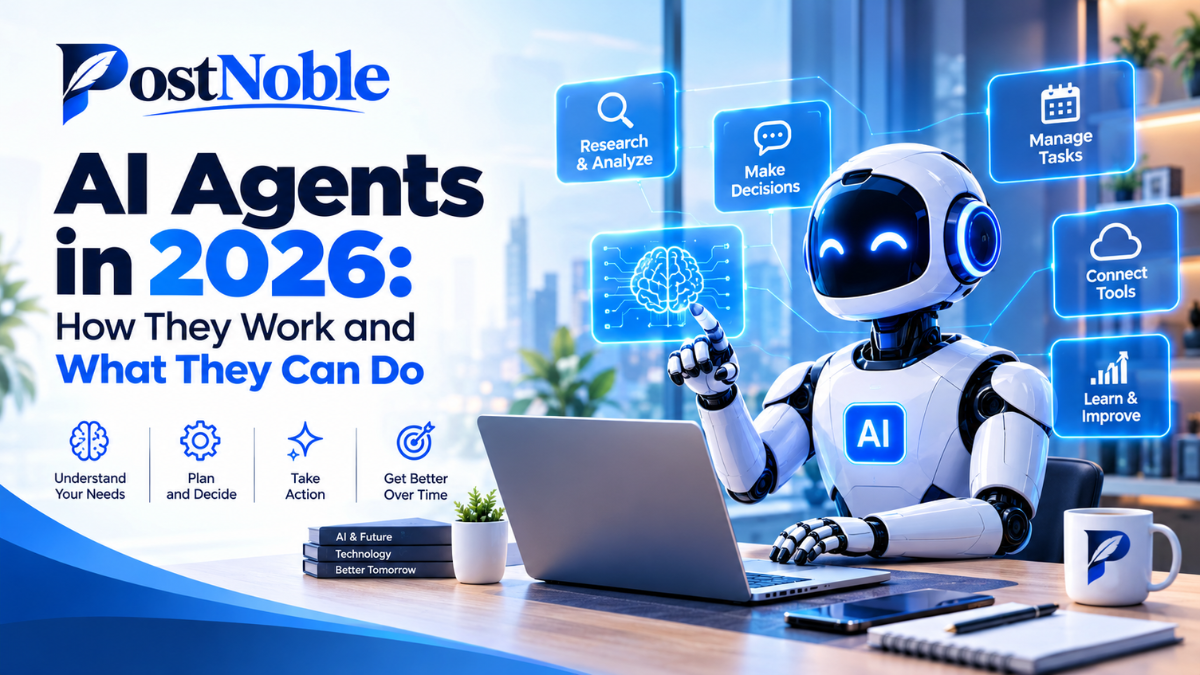
Artificial intelligence is changing how people work, learn, communicate, and manage everyday tasks. While traditional AI tools mainly respond to questions or generate content, a newer generation of technology can take action, make decisions within defined limits, and complete tasks with less human involvement. These systems are known as AI agents.
AI agents in 2026 are becoming increasingly useful for businesses, developers, students, and individuals who want to save time and improve productivity. From organizing schedules to helping customer support teams, AI agents can handle a range of activities that previously required manual effort.
However, AI agents are not magic solutions. They have limitations, require proper instructions, and may need human supervision, especially when dealing with sensitive information or important decisions.
In this guide, PostNoble explains how AI agents work, their practical uses, and what users should understand before adopting them.
What Are AI Agents?
AI agents are software systems designed to pursue specific goals by observing information, deciding what to do next, and performing actions using available tools. Depending on their design, they may search for information, interact with applications, analyze data, or complete several connected steps.
For example, a traditional chatbot might explain how to arrange a business meeting. An AI agent could potentially check an authorized calendar, identify available time slots, prepare an invitation, and request approval before sending it.
The important difference is that an AI agent can move beyond providing an answer and help carry out a task.
Some agents perform simple, predefined actions, while more advanced systems use large language models, external tools, memory, and planning mechanisms to manage complex workflows.
How AI Agents Work
Understanding how AI agents work becomes easier when you look at the process step by step.
First, a user provides a goal, such as researching a topic, preparing a report, or organizing a schedule. The agent interprets the request and determines which actions may help achieve the desired result.
Next, it gathers relevant information from authorized sources. Depending on its capabilities, this might include documents, databases, calendars, websites, or connected business applications.
The agent then selects an appropriate action. It may divide a larger task into smaller steps, use a tool, evaluate the result, and decide whether another action is necessary.
For instance, an agent preparing a market research report might collect information from approved sources, compare findings, organize the main points, and draft a summary.
Finally, the system presents its results or completes the permitted action. Some agents work independently within predefined boundaries, while others pause for human approval before making changes or communicating externally.
The quality of the outcome depends on several factors, including the instructions, available data, connected tools, model capabilities, and safeguards. AI agents can also make mistakes, so important results should be checked.
7 Practical Uses of AI Agents in 2026
AI agents are finding applications across different industries. Here are seven practical ways they can help people and organizations.
1. Automating Everyday Business Tasks
Businesses often spend hours managing repetitive administrative work, including organizing documents, preparing summaries, updating records, and tracking routine requests.
AI agents can help automate these activities by following defined workflows and interacting with authorized software. For example, an agent might extract information from submitted forms, organize it into a structured format, and flag missing details for review.
This can reduce manual work and allow employees to focus on activities that require creativity, judgment, and personal communication.
2. Improving Customer Support
Customer support teams regularly answer similar questions about orders, account access, services, and company policies.
AI agents can retrieve information from approved knowledge bases, provide relevant answers, and guide customers through routine troubleshooting steps. More capable systems may also create support tickets or direct complicated cases to the appropriate team.
Human employees remain important for unusual complaints, sensitive situations, and problems that require empathy or exceptions to company policy.
3. Supporting Research and Content Creation
Researchers, marketers, bloggers, and business owners often need to gather information before creating useful content.
AI agents can help identify relevant sources, summarize documents, compare information, build outlines, and prepare initial drafts. They can also assist with organizing research for articles, presentations, and reports.
For example, a content team could use an agent to develop an article outline, identify questions readers commonly ask, and prepare a first draft for editorial review.
Platforms such as PostNoble can benefit from understanding these workflows when exploring technology, AI tools, and digital productivity.
However, writers should verify facts, check source credibility, and add original insights instead of publishing unreviewed AI-generated material.
4. Managing Personal Productivity
AI agents can help users manage busy schedules by organizing tasks, preparing reminders, summarizing meeting notes, and identifying upcoming deadlines.
When connected to authorized calendar and productivity applications, an agent might suggest suitable meeting times or prepare a daily task summary.
Some systems can coordinate several steps across different applications, reducing the need to switch between tools repeatedly.
Users should still review important calendar changes, messages, and commitments before allowing an agent to finalize them.
5. Analyzing Business Data
Making informed decisions often requires examining sales figures, customer feedback, website performance, and operational reports.
AI agents can assist by collecting authorized data, identifying patterns, comparing performance over time, and preparing summaries in accessible language.
For instance, an online business might use an agent to review weekly website traffic and highlight pages that have experienced a noticeable decline.
These findings can help teams decide where further investigation is needed. Nevertheless, conclusions should be checked against the underlying data, particularly when financial or business decisions are involved.
6. Helping Developers Build and Maintain Software
Software development is another area where AI agents can provide practical support.
Depending on their permissions and capabilities, coding agents can inspect a codebase, suggest changes, generate code, run tests, identify possible bugs, and explain technical problems.
Some systems can complete several development steps in sequence, making them useful for routine maintenance and early-stage prototyping.
However, generated code may contain security vulnerabilities or incorrect assumptions. Developers should review changes, test functionality, and follow established security practices before deploying software.
7. Supporting E-Commerce Operations
Online stores handle product questions, inventory updates, order inquiries, and customer communication. AI agents can help coordinate these activities through connected commerce platforms.
For example, an agent could identify frequently asked questions, summarize customer feedback, prepare product descriptions, or flag inventory records that need attention.
With appropriate permissions, it might also assist with order-status communication or routine record updates.
Businesses should establish clear approval rules for refunds, payments, pricing changes, and other actions that affect customers or company finances.
Benefits and Limitations of AI Agents
AI agents can offer several benefits, including faster task completion, reduced repetitive work, consistent workflows, and better coordination between software tools. They may also help smaller teams handle more administrative work without immediately expanding their workforce.
However, their performance is not guaranteed. Agents can misunderstand instructions, rely on inaccurate information, repeat errors, or take an unsuitable action when their permissions are too broad.
Privacy is another important concern. Connecting an agent to emails, documents, customer records, or company systems creates responsibilities around data access and security.
Organizations should begin with clearly defined tasks, limit permissions to what is necessary, monitor performance, and require human approval for high-impact actions. Testing an agent on a small workflow before expanding its responsibilities is a sensible approach.
What Is the Future of AI Agents?
The future of AI agents will likely involve stronger integration with business software, better coordination between specialized agents, and more reliable ways to complete multi-step tasks.
Rather than using a separate tool for every activity, people may increasingly rely on systems that coordinate research, planning, communication, and routine execution through a single workflow.
At the same time, progress will depend on improvements in accuracy, security, transparency, and human oversight. More automation does not automatically mean better results.
Businesses that understand both the capabilities and limitations of these systems will be better positioned to use them responsibly.
Final Thoughts
AI agents in 2026 represent an important development in artificial intelligence because they can help move tasks from planning toward execution. Their practical applications range from customer support and content research to software development, personal productivity, and business analysis.
Understanding how AI agents work makes it easier to identify where they can save time and where human judgment remains essential.
For readers exploring emerging technologies, PostNoble recommends approaching AI agents with a practical mindset: start with a clear goal, use trusted tools, protect sensitive information, and review important outcomes.
AI agents can make many workflows more efficient, but the best results come when automation and human expertise work together.