
Humanoid Robots in 2026: Uses, Capabilities, and Limitations
Discover how humanoid robots in 2026 are transforming industries, healthcare, and daily life. Explore their capabilities, practical uses, key benefits, and limitations shaping the future of robotics.
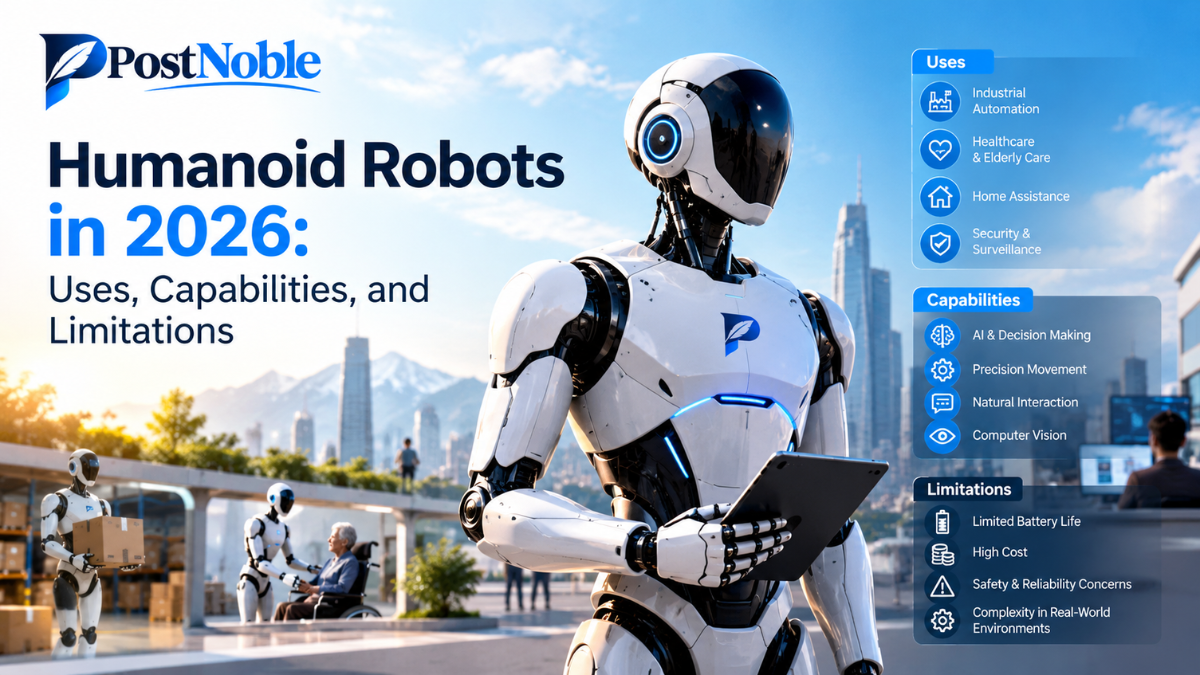
Imagine a robot working alongside employees in a warehouse, helping organize products, or assisting with simple tasks in a busy workplace. What once seemed like a scene from a science-fiction movie is gradually becoming a reality. In 2026, humanoid robots are attracting attention as advances in artificial intelligence (AI), sensors, and robotics make machines more capable of interacting with the physical world.
Unlike traditional industrial robots designed for a single repetitive task, humanoid robots are built with a human-like body, often featuring a head, torso, two arms, and two legs. This design allows them to operate in environments originally created for people, including factories, warehouses, and certain public spaces.
However, their growing capabilities do not mean they can perform every task as effectively as humans. Understanding their practical uses, strengths, and limitations is essential for businesses and individuals interested in this technology.
In this guide, PostNoble explores humanoid robots in 2026, including how they work, where they can be useful, and what challenges still need to be addressed.
What Are Humanoid Robots?
Humanoid robots are machines designed to resemble the human body and perform physical tasks using a combination of mechanical components, sensors, software, and AI systems.
Their cameras and other sensors help them understand their surroundings, while AI models can help them interpret instructions, recognize objects, and decide how to respond. Motors and actuators control their movements, allowing them to walk, reach, lift, or manipulate objects, depending on their design.
Some robots are designed for research and experimentation, while others are being developed for commercial environments. Their abilities vary considerably, so a demonstration of one advanced robot should not be taken as proof that all humanoid robots can perform the same tasks.
7 Practical Uses of Humanoid Robots in 2026
The potential uses of humanoid robots extend across several industries. Their greatest advantage is the possibility of performing physical work in places that already accommodate human workers, without requiring every workspace to be redesigned.
1. Manufacturing and Factory Operations
Manufacturing is one of the most promising areas for humanoid robotics. Factories often involve repetitive activities such as moving components, sorting materials, transporting tools, and handling certain products.
A humanoid robot could potentially assist with these tasks while using equipment and workstations designed for people. AI-powered perception can help it identify objects, while robotic arms allow it to pick up and move items.
However, precise assembly, handling delicate components, and operating safely around workers remain challenging. For many production lines, specialized industrial robots are still faster, more reliable, and more economical.
2. Warehousing and Logistics
Warehouses require employees to move goods, organize inventory, and transport items between different areas. Humanoid robots could eventually help with some of these activities.
For example, a robot might retrieve a container, move products between workstations, or assist with basic material handling. Because warehouses frequently change layouts and contain different types of objects, robots need reliable navigation and object recognition.
Although these capabilities are improving, handling irregular packages, navigating crowded spaces, and working continuously without human intervention can still be difficult.
3. Healthcare and Elderly Assistance
Humanoid robots may eventually support healthcare workers by helping with selected non-clinical activities. These could include delivering supplies, carrying lightweight items, providing reminders, or assisting with basic interactions.
In elderly care, a conversational robot might offer companionship, remind someone about a scheduled activity, or help them contact a caregiver.
Nevertheless, humanoid robots are not replacements for doctors, nurses, or trained caregivers. Physical assistance involving transfers, mobility, or emergencies requires a high level of reliability and appropriate safety measures. Privacy and patient consent are also important considerations.
4. Education and Skill Development
Educational institutions can use humanoid robots to introduce students to robotics, programming, AI, and engineering concepts.
For instance, students might program a robot to recognize objects, respond to spoken commands, or complete a simple movement task. These activities make technical subjects more interactive and give learners practical experience.
Robots can also demonstrate how machines interpret information and respond to changing conditions. However, their value depends on the learning objectives, available resources, and support from teachers rather than simply having an advanced machine in the classroom.
5. Customer Service and Hospitality
Hotels, offices, shopping centers, and other public-facing businesses may use humanoid robots for selected customer service activities.
A robot equipped with speech recognition and conversational AI could answer common questions, provide directions, or guide visitors toward a particular location. Its human-like appearance may also make interactions feel more familiar to some users.
Still, background noise, unfamiliar accents, complicated questions, and unexpected situations can reduce performance. Human employees remain important when customers need personalized assistance, emotional understanding, or decisions that require judgment.
6. Research, Testing, and Hazardous Environments
Humanoid robots can help researchers study human-like movement, machine perception, and autonomous decision-making. Their ability to use human-oriented tools and spaces may also make them useful for testing new automation systems.
In certain hazardous environments, robots could potentially assist with inspection, material handling, or other tasks that expose people to physical risks. However, humanoid robots are not always the best choice for dangerous work. Depending on the environment, wheeled robots, drones, or purpose-built machines may be safer and more practical.
7. Household Tasks and Personal Assistance
Household assistance is an appealing long-term application of humanoid robots. A sufficiently capable machine might help organize objects, carry laundry, retrieve everyday items, or perform simple cleaning-related activities.
The challenge is that homes are unpredictable. Objects may be misplaced, furniture can obstruct movement, and everyday items come in different shapes, sizes, and materials.
A robot must recognize these differences, move safely around people and pets, and handle objects without damaging them. In 2026, general-purpose household assistance remains an evolving area rather than a universally available, fully reliable solution.
Humanoid Robot Capabilities: What Can They Actually Do?
The humanoid robot capabilities available today depend on the hardware, software, and training behind each machine. Some systems can walk, maintain balance, recognize objects, follow spoken instructions, and manipulate selected items.
AI can help robots interpret commands and adapt their actions to changing situations. However, understanding a request does not automatically mean a robot can complete it physically. It may recognize a cup correctly but still struggle to pick it up from a crowded table.
This difference between understanding and execution is one of the most important factors in evaluating humanoid robotics. Real-world performance depends on movement accuracy, response time, battery life, environmental awareness, and the ability to recover from mistakes.
What Are the Main Limitations of Humanoid Robots?
Despite their progress, humanoid robots face several challenges.
High costs: Advanced hardware, sensors, software development, maintenance, and safety systems can make deployment expensive.
Limited battery life: Walking and moving heavy objects require energy. Battery capacity and charging requirements can limit operating time.
Reliability issues: Robots may struggle with slippery floors, unexpected obstacles, fragile objects, or unfamiliar environments.
Safety concerns: A machine with moving limbs must avoid collisions and respond appropriately when people enter its working area.
Privacy risks: Cameras, microphones, and connected AI systems may collect sensitive information, particularly in homes and workplaces.
Human judgment: Robots can follow instructions and recognize patterns, but they do not possess human experience, empathy, or common sense in the same way people do.
These limitations mean that businesses should evaluate robots based on measurable performance and practical needs instead of relying only on impressive demonstrations.
The Future of Humanoid Robots
The future of humanoid robotics will depend on improvements in AI, mechanical design, battery technology, affordability, and real-world reliability. As these systems improve, more organizations may explore them for repetitive physical tasks and carefully defined workflows.
However, adoption will likely differ across industries. A warehouse with structured operations may benefit sooner than a typical household, where every room presents different challenges.
For businesses, the most useful question is not whether humanoid robots can replace people entirely. It is whether a particular robot can perform a specific task safely, consistently, and at a reasonable cost.
Conclusion
Humanoid robots in 2026 represent an important development in the relationship between AI and physical work. From manufacturing and logistics to education and personal assistance, they offer opportunities to automate selected tasks and explore new ways of working.
At the same time, high costs, reliability challenges, safety concerns, and limited adaptability continue to restrict their widespread use.
As discussed on PostNoble, understanding both the potential and the limitations of this technology is essential. Humanoid robots are not ready to do everything humans can do, but continued progress could make them increasingly useful partners in workplaces and everyday environments.