
AI Smart Glasses: Features, Benefits, and Privacy Risks
Discover AI smart glasses features, benefits, and privacy risks. Learn how these wearable devices use AI for daily tasks, improve convenience, and raise important questions about data security and privacy.
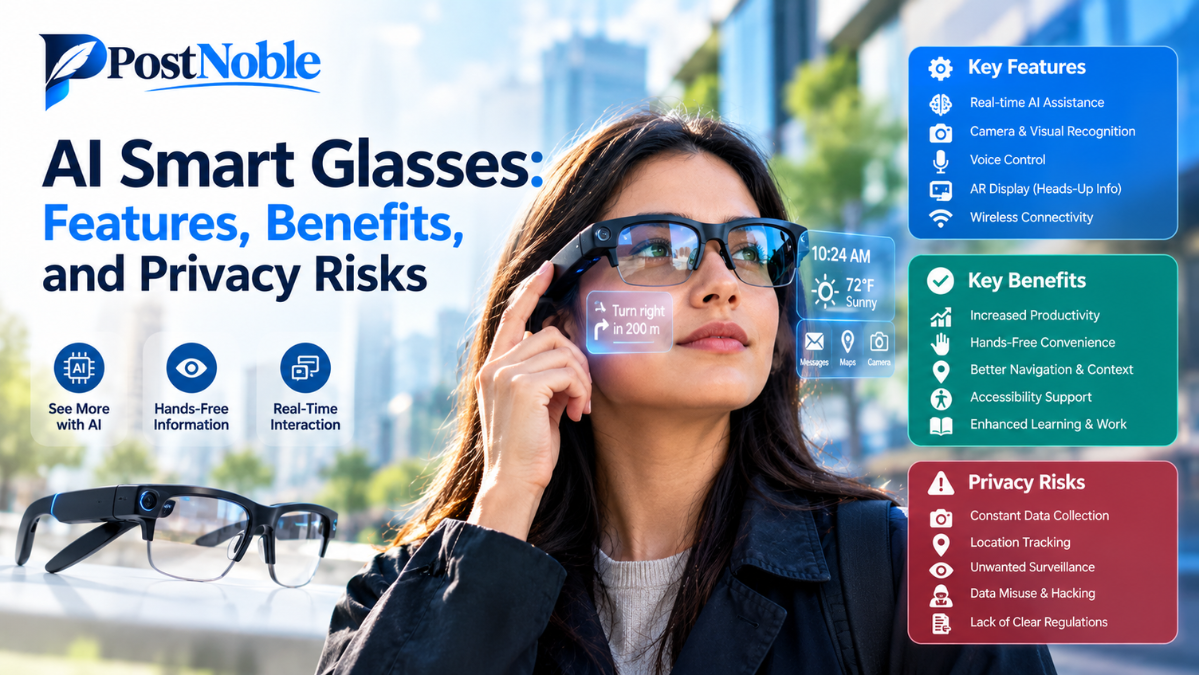
Technology is becoming a natural part of everyday life. Smartphones, wireless earbuds, and smartwatches have already changed how people communicate, work, and access information. Now, another wearable technology is gaining attention: AI smart glasses.
These glasses look similar to regular eyewear but can include cameras, microphones, speakers, internet connectivity, and artificial intelligence. Depending on the model, users can ask questions, capture photos, listen to messages, translate conversations, and access digital assistance without constantly reaching for their phones.
However, this convenience also raises important questions about personal privacy, data security, and responsible use. Before buying a pair, it is worth understanding what these devices can do and where their limitations lie.
In this guide, PostNoble explores the main features, practical benefits, and privacy risks of AI-powered eyewear to help readers make an informed decision.
What Are AI Smart Glasses?
AI smart glasses are wearable devices that combine traditional eyewear with digital technology and artificial intelligence. Unlike ordinary glasses, they can interact with users through voice commands, cameras, microphones, and other built-in components.
Some models focus on photography, calls, and audio assistance, while others offer small displays that show information directly in the user's field of view. More advanced systems may use AI to interpret visual information or provide real-time assistance.
For example, imagine visiting a new city and struggling to understand a restaurant menu written in another language. Depending on the device's capabilities, you may be able to ask your glasses for help instead of taking out your smartphone.
The exact experience varies by product. Not every pair includes a display, live translation, or advanced visual recognition, so checking the specifications before purchasing is important.
AI Smart Glasses Features: 7 Things They Can Do
The appeal of AI eyewear comes from its ability to bring useful digital tools into everyday situations. Here are seven features that explain why this technology is attracting attention.
1. Voice-Controlled AI Assistance
Many AI smart glasses allow users to interact with a built-in assistant through spoken commands. You might ask a question, request general information, or perform a supported task without touching your phone.
This feature can be helpful while cooking, walking, or carrying shopping bags. However, voice recognition may be less reliable in noisy environments, and some requests require an internet connection.
2. Hands-Free Photography and Video Recording
Some glasses include built-in cameras that let users capture photos and videos from their point of view. This can be useful when travelling, attending outdoor activities, or recording everyday moments.
Hands-free recording is convenient because users do not need to hold a phone. Still, they should respect other people's privacy and follow the rules of the location where they are recording.
3. Calls, Music, and Audio Playback
Integrated speakers and microphones allow compatible glasses to support phone calls, music, podcasts, and spoken notifications.
Unlike conventional headphones, some models use open-ear audio, allowing users to hear surrounding sounds while listening. However, sound leakage may affect people nearby, and audio quality differs between devices.
4. Real-Time Language Translation
Certain models and software services offer translation features that can help users communicate across language barriers.
For example, a traveller may use supported translation tools to understand a conversation or follow spoken instructions. Performance depends on language availability, background noise, network access, and the device's software.
Users should not assume that translations are always accurate, particularly during important business, medical, or legal conversations.
5. Visual Recognition and Contextual Information
Some AI-enabled glasses can analyse images or visual information to answer questions about objects, signs, products, or nearby surroundings.
A user might ask what an unfamiliar object is or request help understanding a sign. These capabilities can be valuable, but AI can misunderstand what the camera sees or provide incorrect answers.
For important decisions, users should verify the information rather than treating AI responses as unquestionably correct.
6. Navigation and Everyday Productivity
Depending on the model, smart glasses may provide directions, notifications, reminders, or other information without requiring users to check their phones repeatedly.
Display-equipped devices may show navigation prompts in the user's field of view, while audio-focused models can deliver spoken guidance.
These features can save time, although users should remain aware of traffic, pedestrians, and their surroundings instead of relying entirely on digital instructions.
7. Accessibility Support
AI glasses may help some people with visual or other accessibility needs by describing surroundings, reading supported text, or delivering spoken information.
For someone who finds it difficult to read a sign or identify an object, this assistance could make certain everyday activities easier.
However, accessibility performance varies significantly across devices. These products should complement, rather than automatically replace, established assistive tools and professional guidance.
Benefits of AI Smart Glasses in Everyday Life
AI eyewear offers several potential advantages when its features match the user's needs.
Greater convenience: Users can access supported digital functions without repeatedly reaching for a smartphone.
Hands-free interaction: Voice commands and built-in audio can make selected tasks easier when the user's hands are occupied.
Improved productivity: Notifications, reminders, and quick information access may help people manage everyday activities more efficiently.
New ways to capture experiences: Built-in cameras make it easier to record activities from a first-person perspective.
Potential accessibility improvements: Audio descriptions, text assistance, and translation tools may help users navigate certain situations more independently.
Despite these benefits, smart glasses are not automatically better than smartphones. Their usefulness depends on comfort, battery life, software quality, available features, and how often a person needs hands-free assistance.
AI Smart Glasses Privacy Risks You Should Understand
The same technology that makes these glasses useful can also create privacy challenges. Because some models resemble ordinary eyewear, people nearby may not immediately realise that a camera or microphone is present.
The European Data Protection Board highlighted concerns about recording, personal data, and the rights of people who may be captured without their knowledge in its October 2026 statement on smart glasses.
Here are the main risks users should consider.
Unnoticed Recording
A discreet camera can make it easier to record photos or videos without drawing attention. This may leave other people unaware that their conversations or activities are being captured.
Users should avoid secret recording and seek permission when appropriate, especially in private or sensitive settings.
Personal Data Collection
Depending on the device and its settings, information such as voice commands, captured media, location data, and AI interactions may be processed or stored.
Users should review the manufacturer's privacy policy to understand what information is collected, how long it is retained, and whether it is shared with third parties.
Cloud Processing and Data Security
Some AI functions rely on remote servers because the glasses cannot perform every task locally. This means certain requests or related data may be sent to an online service for processing.
Cloud processing is not automatically unsafe, but it creates additional questions about encryption, access controls, retention, and security practices.
Accidental Activation
Voice assistants and recording controls may sometimes be activated unintentionally. A user might trigger a command by mistake or misunderstand when a feature is active.
Learn how to disable voice activation, stop recording, and review captured content before using the device in sensitive environments.
Misuse in Workplaces and Public Spaces
Recording in offices, classrooms, hospitals, or other restricted areas can expose confidential information and create uncomfortable situations.
Employers and venue operators may have specific rules governing camera-equipped wearables. Users should check these rules before wearing smart glasses in professional or restricted settings.
How to Use AI Smart Glasses More Safely
Responsible use begins with a few straightforward habits.
- Review privacy settings: Understand which features collect data and disable unnecessary permissions.
- Check recording indicators: Learn how the device signals that its camera is active, and never tamper with those indicators.
- Limit sensitive information: Avoid asking AI assistants to process passwords, financial details, confidential documents, or other private information unnecessarily.
- Secure connected accounts: Use strong, unique passwords and available security protections for the companion app.
- Respect consent: Tell people when recording or sharing information could affect their privacy, and obtain permission when appropriate.
- Keep software updated: Install official updates to benefit from available security fixes and improvements.
- Follow local rules: Check applicable laws and workplace policies before recording or using the device in restricted areas.
These steps cannot eliminate every risk, but they can help users make more thoughtful decisions about when and how to use their glasses.
Are AI Smart Glasses Worth Buying?
AI smart glasses may be worth considering if you regularly need hands-free assistance, enjoy capturing first-person videos, travel frequently, or want convenient access to audio and AI tools.
Before purchasing, compare the features you will genuinely use rather than choosing a product simply because it includes artificial intelligence. Consider comfort, prescription compatibility, battery life, camera quality, supported languages, smartphone compatibility, and the manufacturer's approach to privacy.
It is also worth asking whether you need a camera-equipped model at all. If your priority is listening to audio or receiving spoken assistance, a device without a camera may better match your privacy preferences.
Remember that advanced features may require a companion app, a compatible smartphone, an internet connection, or a paid subscription.
Conclusion
AI smart glasses represent an interesting step in wearable technology, bringing photography, audio, digital assistance, and selected AI capabilities into everyday eyewear. They can make certain tasks more convenient and offer promising accessibility benefits.
At the same time, privacy risks deserve serious attention. Recording awareness, personal data collection, cloud processing, and the possibility of capturing people without their knowledge should all influence how these devices are designed and used.
For readers of PostNoble, the key takeaway is simple: choose AI smart glasses for practical value, understand their privacy settings, and use their features responsibly. With the right expectations and careful habits, users can explore this technology while making informed decisions about their personal information and the privacy of others.